 English
 Français
 Español
Fully Auto vs Semi-Auto Bag Making Machine – Differences | TPLAST
You have the film roll loaded, the sealing temperature dialed in, and a stack of orders waiting. But every few bags, someone has to manually remove the finished stack, insert a cardboard core, or re-thread the film. The question isn’t whether the machine can make bags—it’s whether your operators can keep up with it.
The gap between fully automatic and semi-automatic bag making machines is often misunderstood. Semi-automatic does not necessarily mean “slow,” and fully automatic does not always mean “overkill.” This guide walks through the real operational differences, from labor allocation to changeover flexibility, so you can match the machine’s autonomy to your actual production floor reality.
Defining the Two – What “Automatic” Really Means in Bag Making
Both machine types share the same core bag-making steps: film feeding, sealing, cutting, and stacking. The difference lies in which steps require manual intervention and how the machine handles batch completion.
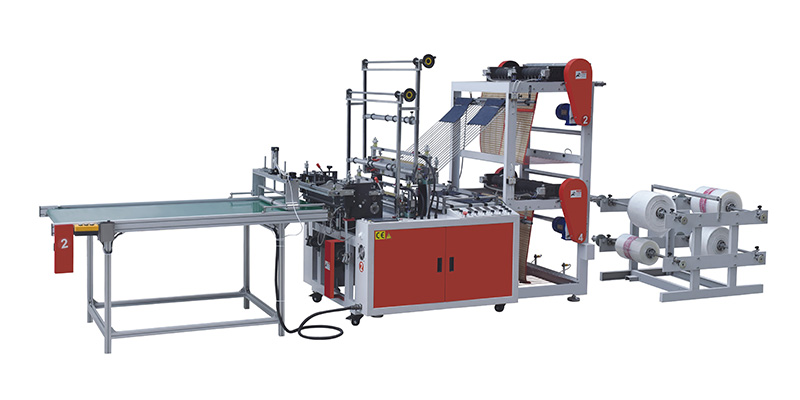
Semi-automatic bag making machine: The machine automatically feeds film, seals, and cuts each bag. However, when a predetermined batch count is reached, the machine stops or signals the operator to remove the finished stack. The operator must manually unload the stack, optionally insert a separator or cardboard interleaf, and then restart the machine. Some semi-automatic models also require manual positioning for the first bag after a roll change.
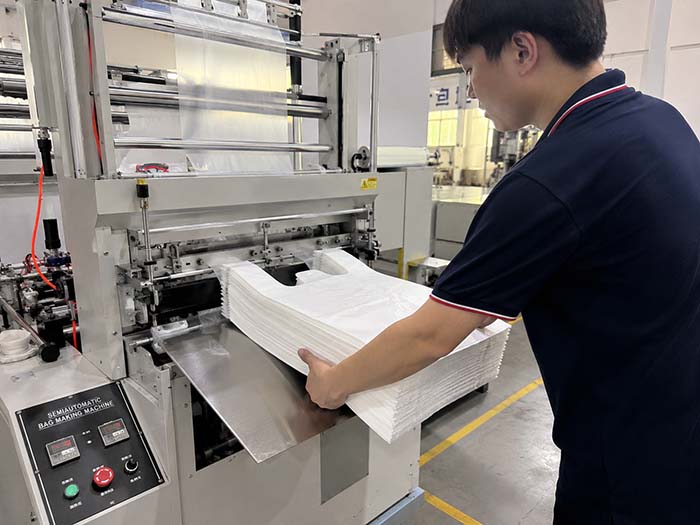
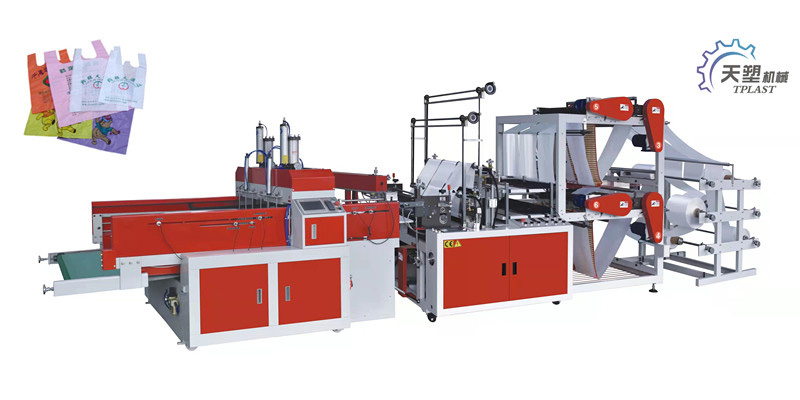
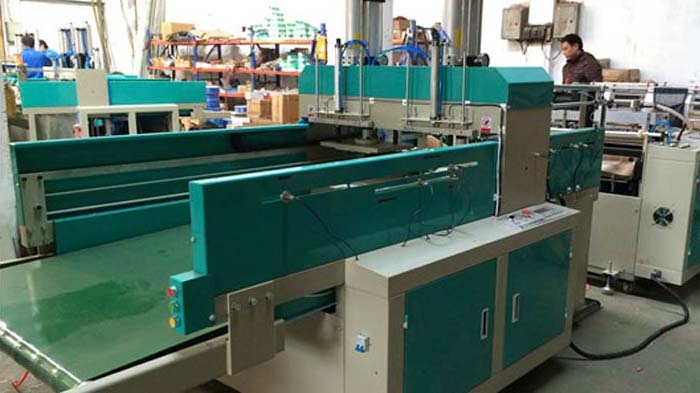
Fully automatic bag making machine: The machine handles the entire cycle without stopping for operator intervention. After cutting a batch, an automatic stacking and conveyor system transfers the finished stack to a packing area. Some fully automatic configurations also include in-line punching, automatic core insertion, and even bundling or packaging. The operator’s role shifts from “unloader” to “supervisor” – monitoring multiple machines rather than tending one.
In practical terms, a semi-automatic machine might produce 40–60 bags per minute but require operator attention every 30–60 seconds to unload. A fully automatic machine can run continuously for hours, with operator attention needed only for roll changes or quality checks.
Once you understand the baseline definitions, exploring specific machine configurations can clarify which automation features are built into different models. See our bag making machine series for an overview of control systems and optional automation packages.
Side-by-Side Comparison – From Labor to Throughput
The table below compares the two automation levels across the factors that directly impact your production cost and daily workflow.
| Comparison Factor | Semi-Automatic | Fully Automatic |
|---|---|---|
| Operator attention per machine | Frequent | Infrequent |
| Number of machines one operator can handle | 1–2 machines typically | 3–6 machines possible with conveyor integration |
| Typical output | 2,400–3,600 | 4,000–7,200 |
| Batch handling | Manual removal, stack separation, optional cardboard insertion | Automatic ejection, conveyor transport, optional bundling |
| Vest bag handle punching | Often requires separate punch unit or manual step | Integrated in-line punching and stacking |
| Material waste | Slightly higher due to restarts and positioning | Lower due to continuous, stable operation |
| Floor space per machine | Less | More |
| Investment range | Lower initial cost | Higher initial cost, but lower per-bag labor cost |
| Changeover time | Faster – operator can adjust manually | Longer – more sensors and automated guides to recalibrate |
A critical nuance: semi-automatic machines are not “slow” in cycle time. The sealing and cutting mechanism can run at the same speed as a fully automatic model. The difference is utilization. A fully automatic machine keeps its sealing head working nearly 100% of runtime. A semi-automatic machine’s sealing head sits idle while the operator unloads stacks.
For example, a machine with a 50-bag batch size running at 60 bags per minute will finish a batch in about 50 seconds. The operator then needs 5–10 seconds to unload and restart. Over an hour, that adds 5–10 minutes of idle time – reducing effective output by 10–15% before accounting for operator fatigue.
Five Questions to Determine the Right Automation Level
Use this checklist to evaluate which type aligns with your production reality.
How many bag making machines do you plan to run simultaneously?
-
1–2 machines → semi-automatic may be cost-effective, especially for varied short runs
-
3+ machines → fully automatic enables one operator to supervise a line, reducing labor cost per machine
What is your average batch size per order?
- Small batches → semi-automatic allows quick changeovers; fully automatic’s setup time may be inefficient
-
Large batches → fully automatic’s continuous run delivers significant labor savings
Do you produce mostly vest bags or flat bags?
-
Vest bags require handle punching. Fully automatic in-line punching reduces separate handling steps
-
Flat bags can be handled well by either, but fully automatic works better for high-volume standard sizes
How experienced is your operator team?
-
Semi-automatic machines rely more on operator skill for alignment and quality. A trained operator can produce excellent results
-
Fully automatic machines reduce operator influence, making quality more consistent across shifts
Do you have downstream packing or bundling needs?
-
If stacks go directly to packing, a fully automatic conveyor can feed into your packing station
-
If manual inspection is required after every batch, semi-automatic’s natural stop point may suit your workflow
For operations that prioritize continuous high-volume output, understanding upstream film consistency is equally important. See how film blowing machine quality affects downstream bag making efficiency and waste rates.
Real Production Scenarios – Matching Automation to Application
Small to medium bag manufacturer with frequent style changes
You produce short runs of printed flat bags, each order between 5,000 and 20,000 bags. You change bag width or length 3–4 times per shift. Your operators are experienced.
Recommendation: Semi-automatic – faster changeover times and lower capital cost make economic sense. The frequent style changes limit the benefit of full automation. One operator can manage two machines, unloading batches during natural pauses.
High-volume vest bag producer for supermarket supply
You produce over 500,000 vest bags per week, mostly in two standard sizes. Orders are long runs, often continuous for days. Your labor cost is rising, and you want to reallocate workers to other tasks.
Recommendation: Fully automatic – the machine’s ability to run without stop for unloading, combined with in-line punching and stacking, will recover the higher investment within 12–18 months through labor savings alone. One operator can supervise four to six machines.
Startup or diversified product line
You are establishing your bag making operation and your order mix includes both small custom runs and occasional large orders. Capital is limited but you expect growth.
Recommendation: Semi-automatic with upgrade path – some manufacturers offer semi-automatic machines that can be retrofitted with automatic stacking units later. This allows you to start lean and add automation as volume justifies it.
From Comparison to Decision–Making: The Right Investment
To summarize, the choice between fully automatic and semi-automatic bag making machines is not about which is “better” in absolute terms. It is about matching the machine’s operational rhythm to your batch sizes, labor availability, and changeover frequency.
-
Choose semi-automatic if you run varied short-to-medium batches, have skilled operators who can handle quick changeovers, and want a lower initial entry cost.
-
Choose fully automatic if you run long, continuous batches of standard bag sizes, want to reduce labor cost per bag, and can justify the higher upfront investment through utilization gains.
Neither decision locks you in forever. Many production floors start with semi-automatic machines for flexibility and add fully automatic lines for their bread-and-butter volumes as they grow.
Related Reading
After determining whether fully automatic or semi-automatic fits your production, these related articles can help you refine your bag making line decisions:
-
Heat Sealing vs. Cold Cutting – Which Bag Edge Finish Suits Your Product Mix?
-
Heat Sealing vs Cold Cutting Bag Making Machine – Which | TPLAST
-
Servo vs. Inverter Drive in Bag Making – Accuracy and Energy Considerations
-
Film Blowing to Bag Making: Building an Integrated Production Line
-
Common Bag Making Defects – Causes and How to Prevent Them
This article is part of TPLAST’s technical content library. No direct sales or pricing information is included. All technical discussions aim to help you make informed purchasing decisions.