 English
 Français
 Español
How to Reduce Film Wrinkles by Optimizing Cooling on a Blown Film Line | TPLAST
You have checked the die gap, verified the resin, and dialed in the extrusion temperatures. Yet the film coming off the line still shows wrinkles—ripples running along the edges, transverse bands across the web, or uneven surfaces that ruin roll quality. The culprit is often hiding in plain sight: the cooling system.
Wrinkles in blown film are rarely caused by a single factor, but cooling is one of the most frequent and most overlooked sources. Uneven airflow, incorrect frost line height, or inadequate cooling capacity can turn an otherwise stable bubble into a wrinkled mess. This guide explains how cooling affects film formation, where wrinkles originate, and what practical steps you can take to optimize your blown film cooling system for smoother, higher-quality film.
Why Cooling Causes Wrinkles – The Bubble Stability Connection
The relationship between cooling and wrinkles starts with the bubble itself. As the molten film exits the die, it expands into a bubble and begins to cool. The cooling air stream does more than just remove heat—it also shapes and stabilizes the bubble. When cooling is uneven or insufficient, the bubble becomes unstable, and that instability translates directly into wrinkles.
The mechanism works like this:
-
Uneven cooling creates uneven shrinkage. If one side of the bubble cools faster than the other, the film shrinks at different rates across the circumference. The resulting stress differential manifests as wrinkles.
-
Bubble instability amplifies defects. The biggest cause of wrinkles in blown film is instability of the bubble between the air ring and the point where the bubble reaches full diameter. When the bubble wobbles or drifts, the film is not uniformly stretched, creating localized thickness variations that become wrinkles after collapsing.
-
Insufficient cooling leaves the film too soft. If the film has not fully solidified by the time it reaches the collapsing frame, the soft film can fold unevenly, creating permanent wrinkles.
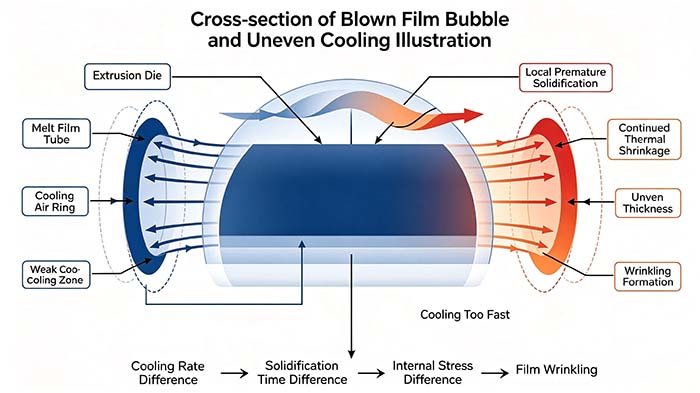
This is why cooling optimization is not a “nice to have”—it is essential for wrinkle-free production.
The Air Ring – Your Primary Cooling Tool and Wrinkle Preventer
The air ring is the first line of defense against cooling-related wrinkles. It blows cool air evenly around the bubble to set the film’s thickness and shape. But if the air ring is not performing correctly, it can just as easily cause wrinkles.
Common air ring issues that cause wrinkles:
-
Uneven airflow distribution: If air distribution is not uniform, it leads to wrinkles or uneven film.
-
Blocked or dirty air vents: Dust, polymer buildup, and oil residues can restrict airflow, leading to localized cooling issues.
-
Misalignment with the die: Even a slight misalignment disrupts the symmetry of the cooling process.
-
Incorrect air velocity: Air velocity may be the single most important variable controlling the rate of cooling.
What you can do:
1. Clean the air ring regularly. Daily cleaning of dust and oil from air ring outlets prevents blockages that cause uneven cooling. During material changeovers, inspect internal passages and diffusers—even small obstructions can throw off the cooling balance.
2. Verify airflow balance. Measure airflow at multiple points around the air ring circumference. High cooling rates need to be consistent around the bubble circumference for optimal film quality. If you detect variations, check the blower, ducting, and air ring entry for restrictions.
3. Check alignment. Misalignment between the die and air ring is a common yet overlooked issue. Use alignment tools during setup to ensure the air ring delivers consistent cooling across the bubble circumference.
4. Consider upgrading the air ring design. Dual-lip air rings offer more precise airflow control than single-lip designs. Modern dual or triple lip designs deliver more uniform cooling by separating air streams into multiple concentric layers. If your line runs the same film structure consistently, elevated air rings and triple lip designs can enable very high outputs. For flexibility across different film types, a dual lip air ring is often a good compromise.
Understanding air ring performance is a key part of selecting the right film blowing machine configuration. See our film blowing machine series for an overview of available cooling system options and configurations.
Internal Bubble Cooling (IBC) – When External Cooling Is Not Enough
For high-output lines or thicker films, external air ring cooling alone may not provide sufficient or uniform cooling. Internal Bubble Cooling (IBC) systems cool the film from inside the bubble as well as from the outside.
How IBC helps reduce wrinkles:
-
Faster, more even cooling: IBC provides better control of film gauge and can improve film clarity.
-
Higher output without sacrificing quality: Adding an IBC system can increase output by 20 percent or more, as long as cooling is the only limitation. Some systems report up to 50% output increases with additional benefits including improved clarity.
-
Better symmetry: For demanding applications like multi-layer film, combining internal and external cooling maintains film symmetry and reduces defects caused by heat imbalance between layers.
Important considerations: IBC systems add complexity—they require chilled air capacity, additional blowers for inlet and exhaust streams, and bubble diameter sensing and control devices. Also, with internal bubble cooling, the bubble is set faster to enable higher production rates, which can increase the chance of freezing surface irregularities. Proper tuning is essential.
For many operations, a dual cooling approach—combining an optimized air ring with IBC—offers the best results for demanding applications.
For operations running multi-layer films or high-output lines, IBC integration can significantly improve film quality. See how different film blowing machine configurations support various cooling approaches.
The Frost Line – Your Visual Indicator of Cooling Health
The frost line—the point where the molten film solidifies—is one of the most important diagnostic tools for cooling-related wrinkles. An uneven frost line indicates non-uniform cooling or uneven film gauge.
What an uneven frost line tells you:
-
Tilted frost line: Anything that disrupts cooling uniformity—whether volume, temperature, or alignment—can cause a tilted frost line.
-
Frost line too high: The film is cooling too slowly, which can lead to sagging and longitudinal wrinkles.
-
Frost line too low: The film is cooling too quickly, which can freeze in surface irregularities.
How to adjust the frost line:
-
Lower the frost line: Increase cooling air volume or reduce air temperature. When more cooling air is blown against the bubble, the frost line drops.
-
Raise the frost line: Reduce cooling air volume or increase extrusion output. Raising the frost line gives the film more time to solidify, resulting in a smoother surface and higher clarity.
The goal is a level, stable frost line around the entire bubble circumference. If you see the frost line tilt or wander, investigate the cooling system immediately.
Beyond the Air Ring – Other Cooling-Related Wrinkle Sources
While the air ring is the primary cooling tool, wrinkles can also originate elsewhere in the cooling and handling path.
Herringbone frame issues:
The angle of the herringbone plates affects how the bubble collapses. If the angle is too large, the bubble is flattened over a short distance, causing wrinkles. Typical herringbone plate angles range from 100–120°. Adjust the angle and ensure even pressure across the collapsing frame.
Nip roll and tension issues:
Cooling continues even after the film passes through the nip rolls. If nip roll pressure is inconsistent—one side high, the other low—the film can wrinkle. Check nip roll pressure uniformity and ensure roller surfaces are clean and smooth.
Air turn bars:
After collapsing, the film passes over air turn bars. Larger diameter air turn bars help reduce wrinkles. Specially designed air turn bars can help ensure wrinkle-free film. If you see wrinkles appearing after the collapsing frame, inspect the turning bars for wear or misalignment.
A Practical Cooling Optimization Checklist
Use this checklist to systematically address cooling-related wrinkles on your blown film line:
Daily checks:
-
Clean air ring outlets—remove dust and oil residue
-
Visually inspect the frost line—is it level and stable around the circumference?
-
Check for any unusual bubble wobble or drift
-
Verify air ring is centered over the die
Weekly checks:
-
Inspect air ring internal passages and diffusers for obstructions
-
Measure airflow at multiple points around the air ring—look for variations
-
Check ducting for insulation damage or excessive bends
-
Verify blower and chiller are delivering sufficient cool air
Monthly/quarterly checks:
-
Deep clean air ring components
-
Verify die and air ring alignment
-
Inspect herringbone plate angle and pressure uniformity
-
Check nip roll pressure balance and surface condition
-
Review cooling system performance data—is energy consumption per unit output increasing?
When changing materials:
-
Purge thoroughly to prevent cross-contamination
-
Re-evaluate cooling parameters for the new material
-
Clean air ring if processing materials with high additive content
From Cooling Optimization to Production Line Integration
Cooling optimization is not an isolated task—it connects to every other part of the blown film process. A well-cooled bubble produces film with consistent thickness, good mechanical properties, and minimal wrinkles. That film then feeds into downstream processes like bag making or printing.
Once you have stabilized your cooling system and reduced wrinkles, the next logical step is to ensure the rest of your production line is equally optimized. Film that runs wrinkle-free through the collapsing frame and winder will also perform better in downstream converting operations.
Related Reading
After optimizing your cooling system to reduce wrinkles, these related articles can help you further improve your blown film production:
-
Common Film Defects in Blown Film Production – Causes and Prevention
-
How Often to Clean the Die Head on a Film Blowing Machine?
-
Film Blowing to Bag Making: Building an Integrated Production Line
-
Understanding ABA Co-extrusion vs. Single-layer Film Blowing
-
Troubleshooting Bubble Instability in Film Blowing
This article is part of TPLAST’s technical content library. No direct sales or pricing information is included. All technical discussions aim to help you make informed purchasing decisions.